
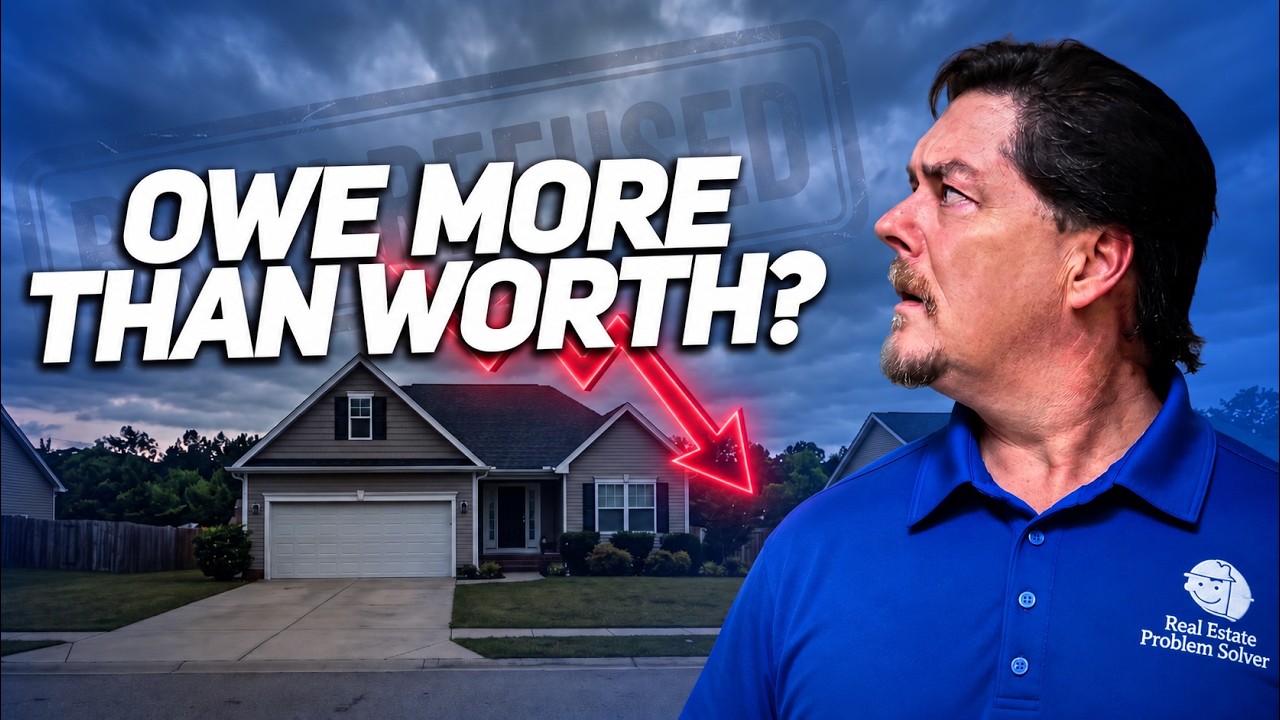
What Can You Do if You Owe More Than Your House Is Worth in Georgia? 5 Options Explained
Yes, you can sell a house when you owe more than it is worth, but not the way most people think. You can bring cash to closing, ask the bank to approve a short sale, rent the house out until the market changes, try a loan modification, or sell as-is to an investor for a fast cash close. In 2013 I bought a co-worker's house at Robins AFB in 13 days, and he paid nothing out of pocket. I am a real estate agent and investor who helps families sell a house in Warner Robins and avoid foreclosure, and here is what each option costs and what to watch out for.
Last updated: November 5, 2026
Watch: Selling Your Home for Less Than You Owe? What Happens Next?
What Does It Mean to Owe More Than Your House Is Worth?
A house is underwater when it is worth less than you owe on the loan. The old saying is that anything is only worth what somebody is willing to pay. You can sell a pencil for a million dollars if you find somebody willing to pay cash, and a house is no different. One day a house can be worth $500,000, and the next week you could not give it away. Worth is in the eye of the beholder.
The last time we had a mass number of underwater homes was around 2013, and there are signs it is starting to happen again. ICE's August 2026 Mortgage Monitor, a mortgage data and analytics report covered by Real Estate News, counted about 813,000 underwater borrowers in the U.S. at the end of June 2026, up 44% from a year earlier, and about 320,000 of them were also behind on their payments. Most were FHA or VA borrowers who bought in 2022 or later, and the biggest concentrations were in Texas and Florida. Georgia was not broken out, and overall home equity is at a record high, so this is rising from a small base. Based on what I am seeing, I expect more families to end up in this spot over the next few years.
What Is Phantom Equity?
Just because a house is worth a certain amount on paper does not mean you can get a buyer to pay that amount in real life. I call the difference phantom equity: equity that shows up on paper and disappears when you sell.
In 2013, a co-worker of mine at Robins AFB spent a year trying to sell his house. It appraised for $130,000 and he owed $115,000, so on paper he had equity. But every offer came in around $100,000, and the buyers wanted him to pay closing costs and agent fees, which meant he would walk away from the table with about $90,000. To pay off a $115,000 loan, he would have had to come out of pocket about $25,000.
Here is a recent example. A family called me about their house. Their loan balance was $153,000, but when I met with them the payoff, with interest and court fees, was about $200,000. On paper the house could be worth $250,000, which looks like $50,000 in equity. But the house needs $30,000 to $40,000 in repairs to reach full retail price, and I told their full story in my post on how their loan modifications raised their payment.
Line | Amount |
|---|---|
House value once it is fixed up | $250,000 |
Payoff owed to the bank (balance was $153,000) | $200,000 |
Equity on paper | $50,000 |
Repairs needed to reach full retail price | $30,000 to $40,000 |
Equity after repairs | $10,000 to $20,000 |
Selling costs, about 10% of the price | About $25,000 |
What is really left | About $5,000 to $15,000 short |
This is one family's real numbers when I met with them. Your numbers will differ.
Selling costs are the part people forget. In my experience, about 90% of the time the buyer asks the seller to pay closing costs and some agent fees, and about 10% of the sales price goes toward the expense of selling the house. So when you run your numbers, take 10% off the top.
How Do You Run Your Real Numbers?
Ask your lender for the payoff amount, not just the loan balance, because interest and fees add up.
Subtract the repairs needed to bring the house to full retail price. My post on which repairs are worth it before you sell can help.
Take about 10% of the sales price off for selling costs.
What is left, or what you are short, is your real equity.
Five Options When You Owe More Than Your House Is Worth
Option | What it is | What to watch out for |
|---|---|---|
1. Bring cash to closing | You pay the shortfall at the closing table | You come out of pocket, about $25,000 in the 2013 example |
2. Short sale | The bank agrees to take less than you owe | The bank must approve it, and forgiven debt can count as taxable income |
3. Rent it out | A tenant pays the mortgage while the market changes | The rent may not cover the payment, escrow, repairs, and taxes |
4. Loan modification | You ask the bank to restructure the loan | One family's payment went up every time |
5. Sell as-is to an investor | A cash offer with no repairs and a fast close | I buy houses, so I am not a neutral party, so compare every option |
Option 1: Bring Cash to Closing
The first option is to bring cash to closing. When you add up all the expenses and repairs and whatever is left owed to the bank, you pay that out of pocket. For my co-worker, it would have been about $25,000. This is not for you if you cannot cover the shortfall.
Option 2: Do a Short Sale
A short sale means getting permission from the bank to sell the house for less than you owe. You put the house on the market and get offers. It does not matter what the offers are at first. Then you present them to the bank and see whether it will take them. For the family above, with a $200,000 payoff, an offer of $190,000 or $195,000 would mean asking the bank to accept a $5,000 or $10,000 loss. If the bank accepts, you go to closing. If it does not, you keep the house on the market until someone offers enough for the bank to approve.
Before you start, ask your lender how a short sale will be reported on your credit, and ask for the remaining balance to be released in writing. Have a real estate attorney review that paperwork.
The Short Sale Tax Trap
When you sell for less than you owe, the difference can count as income, and you could owe taxes on it. According to IRS Topic 431, the federal exclusion for canceled debt on a main home applies only to debt forgiven before January 1, 2026, or forgiven under a written agreement made before that date. The exclusion for people who are insolvent still exists, and the lender may send a Form 1099-C. A bill to restore the home debt exclusion, H.R. 917, was introduced in February 2025 and referred to the House Ways and Means Committee, and I found no further action on it. I am not a tax professional, so see a CPA before you sign anything. My interview with a Perry CPA in Georgia home sale tax strategies covers the other tax side of selling.
Option 3: Rent the House Out Until the Market Changes
We have helped a lot of people this way. We rent the house to another couple while you go buy your next house, and somebody else pays for this one until the market changes and you have enough equity to sell. If you need a property manager, visit betterthanpropertymanagement.com. Will the rent cover the whole mortgage? That depends on your mortgage, your escrow, and what the house rents for. If you owe $1,300 a month and the house rents for $1,500, the rent may cover the mortgage and pay it down while you wait. If it rents for $1,300, you may come out of pocket a little for repairs, taxes, and insurance. Ask yourself whether you would rather come out of pocket $1,300 a month or a couple of hundred.
As long as the mortgage stays paid, renting avoids the credit hit from missed payments, bankruptcy, or foreclosure, and it avoids the tax bill on forgiven debt. I can help you lose less.
Option 4: Ask for a Loan Modification
With a loan modification, you contact the bank, tell them you are having trouble, show them proof of your hardship, and ask them to restructure the loan. Before you do, read how it went for the family in my loan modification post. Their payment went from $980 to $1,250 to about $1,750, up with each workout. If your payment goes up every time, is it really helping you?
Option 5: Sell As-Is to an Investor
The fifth option is selling the house as-is to an investor like me. A cash offer means no hassle and no repairs, and a cash sale can close in as little as 7 to 14 days. In 2013, the bank turned my co-worker down for a short sale. He tried renting the house, and the tenant quit paying. Then he called me. We bought the house and closed in 13 days. His entire $115,000 loan was paid off, he did not come out of pocket a dollar, and there was no forgiven debt to tax. It took him a year of fumbling through it before he called, but once we agreed, it was done in record time.
I am an investor and I buy houses, so I am not a neutral party. Compare every option, and see how a cash sale stacks up against listing in listing versus a cash offer in Middle Georgia. If you are also behind on payments, read how to sell a house in foreclosure in Georgia and my stop foreclosure in Georgia page. If you have to move before the sale closes, here is how a remote closing works.
Frequently Asked Questions About Owing More Than Your House Is Worth
Can I sell my house if I owe more than it is worth?
Yes. You can bring cash to closing to cover the shortfall, ask your lender to approve a short sale, rent the house out until the market changes, try a loan modification, or sell as-is to an investor. Which one fits depends on how much you owe, what repairs the house needs, and how much cash you have.
What is phantom equity?
Phantom equity is equity that exists on paper but disappears when you sell. Take your fixed-up value, subtract repairs and your full payoff, then take about 10% of the sale price off for selling costs. One family's house could be worth $250,000 with a $200,000 payoff, but after $30,000 to $40,000 in repairs and selling costs, there was no real equity left.
What is a short sale and how does it work?
A short sale is when your lender gives permission to sell the house for less than you owe. You list the house, collect offers, and present them to the bank. If the bank accepts an offer, you go to closing. If not, you keep marketing the house until a buyer offers enough for the bank to approve.
Will I owe taxes if I do a short sale?
Possibly. The difference between what you owed and what the bank accepted can count as income. The federal exclusion for forgiven debt on a main home applies only to debt forgiven before January 1, 2026, or under a written agreement made before that date, though an insolvency exclusion may still apply. A bill to restore it has been introduced, but I found no action on it. See a CPA before you sign anything.
Can I rent my house out instead of selling it when I owe more than it is worth?
Yes, if the rent covers most of your payment. If you owe $1,300 a month and the house rents for $1,500, the rent may cover the mortgage while you wait for the market to change. If it rents for $1,300, you may come out of pocket a little for repairs, taxes, and insurance. As long as the mortgage stays paid, you avoid the credit hit from missed payments, bankruptcy, or foreclosure.
How fast can an investor close on a house I owe too much on?
A cash sale can close in as little as 7 to 14 days. I bought a co-worker's house at Robins AFB in 13 days, paid off his entire $115,000 loan, and he did not come out of pocket a dollar. I am an investor and I buy houses, so I am not a neutral party, and you should compare every option.
Ready to Find Out Where You Really Stand in Middle Georgia?
If you owe more than your house is worth in Houston, Bibb, Peach, or Pulaski County, call or text me at (478) 273-8880 or book a time to talk. We will run your real numbers, including the payoff, the repairs, and the selling costs, and come up with a game plan that fits your situation, whether that means a sale, a short sale, renting, or something else. I am not an attorney or a tax professional, so I also suggest talking to a real estate attorney and a CPA. My clients rate me 5.0 stars across 20 Google reviews and 2 Zillow reviews, as of October 2026.